
Atlantic Route of Return
Northern Passage
The northern section of the Atlantic Route of Return. It opens out in the ocean at Cidade Velha on Cabo Verde, where the Atlantic system first took shape, then follows the western shores from Gorée and the Gambia River to Bunce Island and Freetown. Bookable on its own, or joined with the Southern Passage as one continuous journey.
For many travellers from the African diaspora, this journey is not tourism. It is a return.
This journey is designed with particular care for memory, dignity and respectful interpretation. The places visited hold profound historical weight. Southern Cross works with local heritage communities, memorial custodians, diaspora voices and specialist historians so that every encounter honours the people whose stories these landscapes hold. This journey examines the history of enslavement as history, not as romance.
Senegambia and the Rice Coast
The Atlantic Route of Return follows places of memory along the West African coast, from Senegal to Benin. Because the full route crosses several countries and a wide stretch of coast, it is offered in two sections, each one bookable on its own. This is the Northern Passage, the western shores of Senegambia and the Rice Coast. This journey is built for the growing movement of diaspora travellers returning to West Africa to trace their roots.
The Passage opens with a prologue in the ocean. Cidade Velha on the island of Santiago, Cabo Verde, was the first European town built in the tropics and one of the earliest crossing points of the Atlantic system. Set on islands that were uninhabited before the trade, it was a place where enslaved people from the West African coast were held before the ocean crossing, and where one of the first Creole societies was formed. It gives the route its starting point, where the system began, before the journey reaches the mainland shores.
Gorée and Kunta Kinteh Island are the northern departure points on the mainland, where the rivers and coasts of Senegal and the Gambia carried people from the interior to the sea. South along the coast, Bunce Island in Sierra Leone was the principal British slave castle of the Rice Coast, and the place from which the ancestors of the Gullah and Geechee communities of the American South were taken. Sierra Leone also holds the story of return: from 1787, Freetown was settled by freed people, and after 1808 it became the base from which the Royal Navy released those it freed from slave ships.
This section follows places of memory connected to the UNESCO Routes of Enslaved Peoples: Resistance, Liberty and Heritage Programme. It can be travelled on its own, or joined with the Southern Passage (Ghana and Benin) as one continuous journey of return.
From the Atlantic Islands to the Rice Coast

Indicative route framework for the Northern Passage, from the Atlantic islands of Cabo Verde to the Rice Coast. Stations, pacing and flights are arranged during private route design and subject to operational feasibility.
Four Stations, One Continuous Thread

Cidade Velha & the Island of Santiago
Arrive at Praia and travel the short distance to Cidade Velha, the old Ribeira Grande. Founded in 1462, it was the first European town built in the tropics. The islands were uninhabited before the Portuguese came, so the society that grew here was formed almost entirely from the meeting of European settlers and enslaved West Africans.
Set on the sea routes between Africa, Brazil and the Caribbean, the town became an early platform of the Atlantic trade in enslaved people, a place where captives were held and the trade was administered. At its heart stands the Pelourinho, the marble pillory of the early sixteenth century, where enslaved people who resisted were punished in public. Above the bay rises the royal fortress of São Filipe, and below it stand two of the oldest colonial churches in the world, and the ruins of the cathedral.
From this same meeting of peoples came one of the first Creole societies, with its own language and culture. The prologue holds both truths together, the weight of the trade and the endurance of the people who came through it.

Dakar & the Island of Gorée
A short flight from Praia to Dakar. The 20-minute ferry to Gorée Island crosses a harbour that once held slave ships. The Maison des Esclaves and its Door of No Return became one of the most powerful symbolic departure points of the transatlantic system. The island is small enough to walk in an hour. Its weight is immeasurable.
You stay in Dakar, a city of Senghor, of Négritude, of contemporary African art and music, and cross to the island by ferry. Gorée is approached with time and quiet, not as a single stop on a busy schedule.
Kunta Kinteh Island & the Gambia River
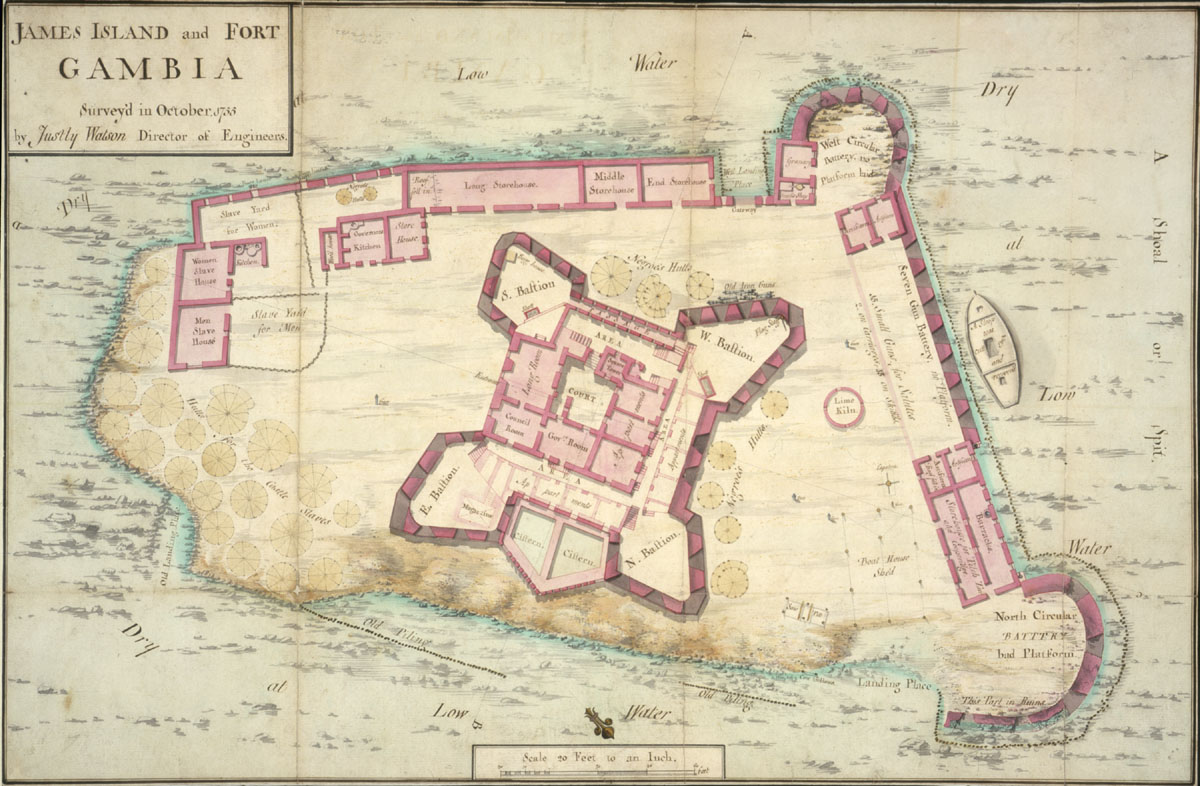
A short flight to Banjul. Kunta Kinteh Island, formerly James Island, sits in the Gambia River, the waterway that carried enslaved people from the interior to the Atlantic coast. The island and its related sites document the river not as geography but as a corridor of forced movement.
The name honours the ancestor from Alex Haley’s Roots, a story that returned a generation of the diaspora to this river and to the question of where their families began.

Bunce Island & Freetown
A flight to Freetown, then by boat up the Sierra Leone River to Bunce Island. Established by English traders in 1670, it was the principal British slave castle of the Rice Coast. From here, enslaved people skilled in rice cultivation were shipped above all to South Carolina and Georgia, where planters paid more for their knowledge. Those captives and their descendants are the Gullah and Geechee of the southern coast of the United States, who carried language, foodways and craft across the Atlantic and held them. The connection between Sierra Leone and the Gullah is among the clearest and most documented links between a single place in Africa and a living diaspora community.
Sierra Leone also holds the other half of the story. From 1787, freed people were settled at Freetown. After 1808 the city became the base from which the Royal Navy intercepted slave ships and released the people aboard them, the “re-captives,” into the colony. In the interior, communities such as those on the heights of Old Yagala had earlier withdrawn to high ground to resist capture. This is a coast of both forced departure and return.
Bunce Island is on the UNESCO Tentative List and is a place of memory rather than an inscribed World Heritage Site.
How the Section Connects
The Northern Passage follows the western shores of West Africa by short scheduled flights, so that it remains open to travellers across the diaspora and not only to private charter. Some routes run only a few times a week, so the rhythm of the journey follows the rhythm of the flights. Private charter can be arranged as an option, to add comfort or to draw the schedule tighter.
The journey begins in the Atlantic, at Praia on the island of Santiago. Nelson Mandela International Airport is served by flights from Lisbon and other European and West African points. Cidade Velha lies a short drive from the city.
Around 660 km · approximately 1 hour
Scheduled flights connect the islands to the mainland. The ferry to Gorée Island runs from central Dakar.
Around 165 km · 40 to 50 minutes
Scheduled flights several times a week (Air Senegal and other carriers). Road transfer is also possible in around four to five hours.
Around 750 km · approximately 1 hour 30 minutes
Served by a small number of scheduled flights each week, sometimes routed via Conakry or Dakar. The boat excursion to Bunce Island departs from Freetown. Private charter is available as an alternative.
The section closes at Freetown, with onward international connections, or a connecting flight to Accra to continue into the Southern Passage. Scheduled flight routings, carriers and frequencies are indicative and change over time. Any private charter is arranged through selected licensed aviation partners and is subject to availability, operational approval and final route validation.
Three UNESCO World Heritage Sites
Cidade Velha, Historic Centre of Ribeira Grande
The first European town in the tropics, and an early platform of the Atlantic trade in enslaved people. A royal fortress, two of the oldest colonial churches, and the marble Pillory Square, on the island of Santiago, Cabo Verde.
Island of Gorée
One of the most powerful symbolic departure points of the transatlantic system. The Maison des Esclaves and the Door of No Return, off the coast of Dakar.
Kunta Kinteh Island and Related Sites
The Gambia River as a corridor of forced movement. Named after the ancestor from Alex Haley’s Roots.
Bunce Island
The principal British slave castle of the Rice Coast, and the source of the Gullah and Geechee diaspora. A place of memory on the UNESCO Tentative List, not an inscribed World Heritage Site.
References to UNESCO are factual references to UNESCO World Heritage Sites inscribed on the World Heritage List, to sites on the UNESCO Tentative List, and to the UNESCO Routes of Enslaved Peoples Programme. Southern Cross Experiences is an independent travel company and does not imply UNESCO endorsement of its journeys.
Designed Around You
This itinerary is a route framework, not a fixed departure. Each Southern Cross journey is privately curated around your dates, travel rhythm, interests and preferred level of comfort. The route can be shortened, extended, or combined with another SCE journey, subject to aviation logistics and operational feasibility.
The Northern Passage can be joined with the Southern Passage (Ghana and Benin) to travel the full Atlantic Route of Return as one continuous journey of return.
Continue the Thread
The complete journey of return, from the Atlantic islands and Goree to the Door of Return. The Northern Passage is its first half.
The second half, from Cape Coast and Elmina through the Asante Kingdom to the Door of Return at Ouidah. Ghana and Benin.
Discuss This Journey
This section is available for private groups, diaspora heritage travel, academic study tours, and selected travel partners. For many travellers from the African diaspora, this journey is not tourism, it is a return. We design it with that understanding.
Begin Planning the Northern Passage