
Tunisia and its Mediterranean World Heritage
A helicopter expedition through the layered civilisations of Tunisia: the Phoenician city-state of Carthage that challenged Rome, the Roman monuments of El Jem and Dougga, and the Islamic city of Kairouan at the heart of what the Arabs called Ifriqiya. Five UNESCO World Heritage Sites across one of the Mediterranean's deepest historical landscapes, connected by short scenic flights.
Tunis · Carthage · Kairouan · El Jem · Dougga
Three Civilisations on One Shore
Tunisia holds one of the most layered heritage landscapes in the Mediterranean world. On this single shore, three civilisations met and built in turn: the Phoenician and Punic world of Carthage, the Roman cities that followed, and the Islamic culture of Ifriqiya, the name the Arabs gave to this corner of North Africa. The result is a country where Punic harbours, Roman amphitheatres and one of the oldest mosques in the Maghreb stand within a short journey of one another.
Carthage was not a Roman foundation but a rival to Rome. The Phoenician city-state contested control of the western Mediterranean across the Punic Wars before its destruction and later Roman rebuilding. To follow Tunisia honestly is to hold both the city that challenged Rome and the empire that absorbed it, and then the Islamic world that rose afterward at Kairouan.
This expedition connects these layers by helicopter. The overland legs between Tunis, Kairouan, El Jem and Dougga are short panoramic flights of twenty to fifty minutes, with ground access where a site has no landing point of its own. Within Tunis, Carthage and the Bardo are reached by private city transfer. Tunis serves as the base for Carthage and the Medina; the centre and south hold Kairouan and the amphitheatre of El Jem; the north-west holds the hilltop city of Dougga. A compact country, deep in history, traversed at an unhurried pace.
A Compact Country, Traced by Helicopter
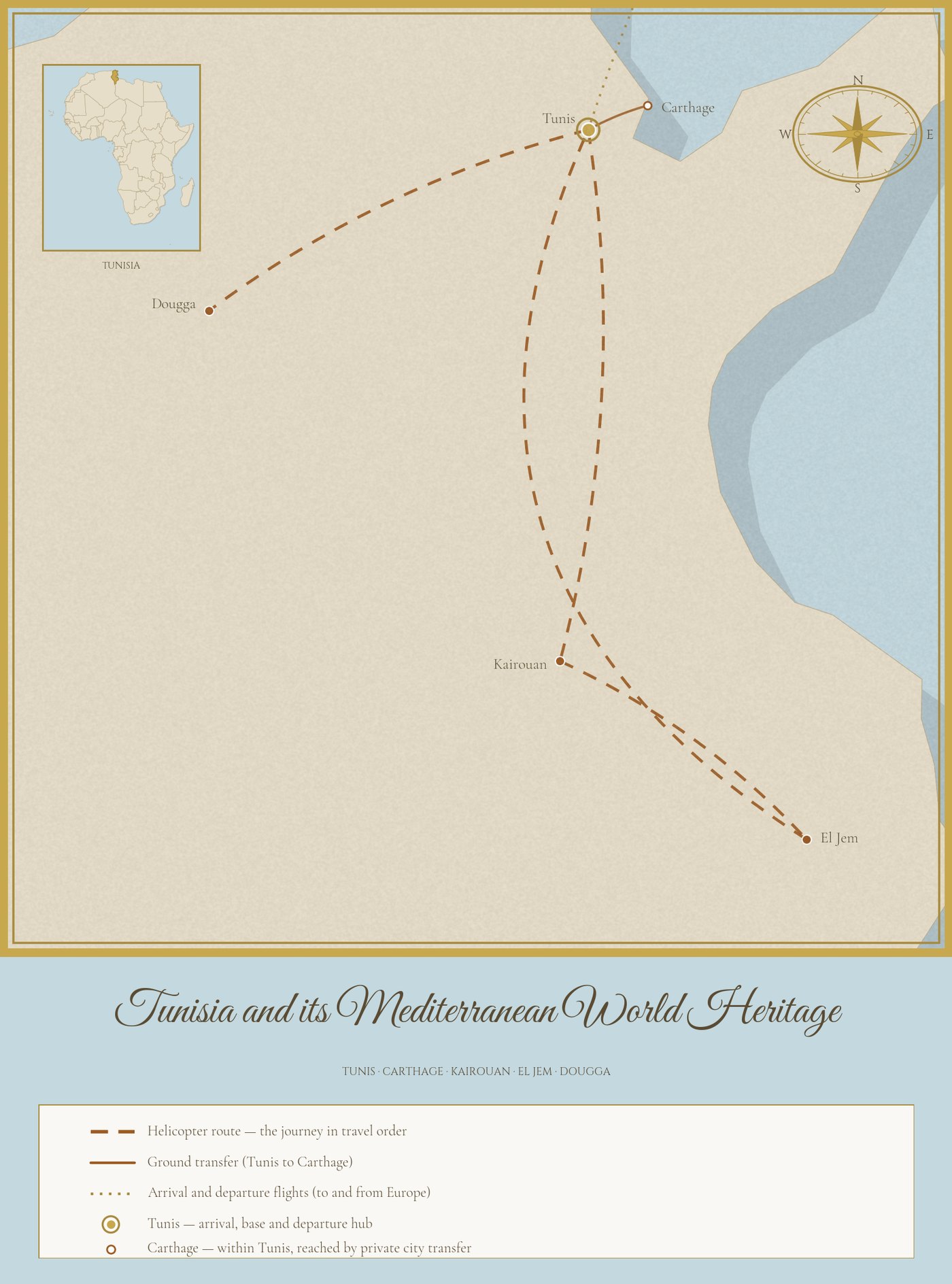
The overland legs are flown by helicopter; Carthage is reached by private city transfer within Tunis. Tunis serves as the arrival, base and departure hub.
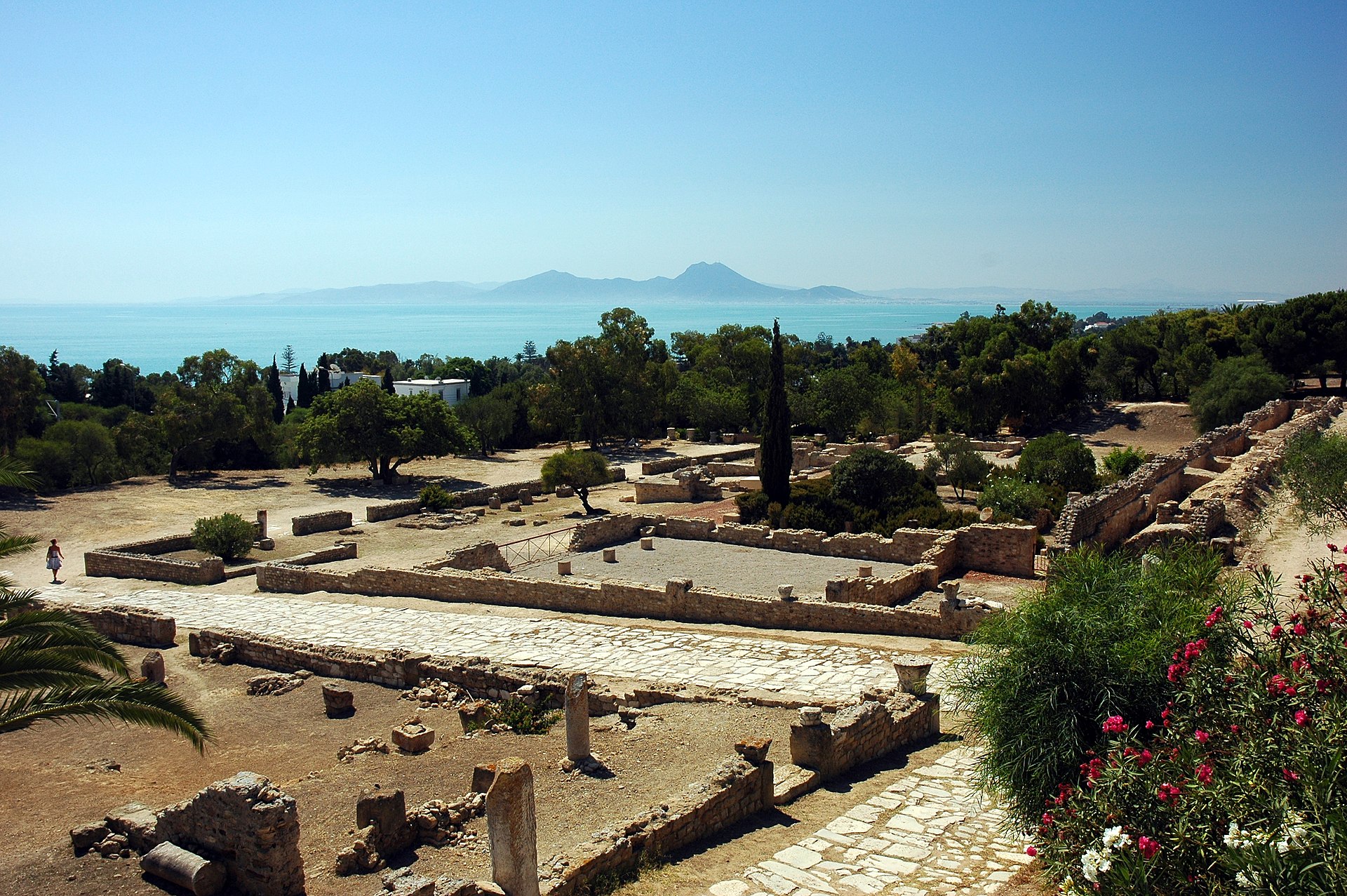
Tunis & Carthage — The Empire
Arrive in Tunis. The Medina of Tunis (UNESCO 1979) holds some 700 monuments, among them palaces, mosques, mausoleums and fountains, one of the most complete medieval Islamic urban landscapes in the Maghreb.
Carthage (UNESCO 1979) was the Phoenician city-state that challenged Rome for control of the western Mediterranean. The Antonine Baths, the Tophet, the Punic harbours: among the most significant archaeological sites in the Mediterranean world. Continue to Sidi Bou Said, the blue-and-white cliff village overlooking the Gulf of Tunis.

Kairouan — The Sacred City of Ifriqiya
Kairouan (UNESCO 1988), founded in 670 CE, is one of the most important historic Islamic cities of the Maghreb and a major centre of religious learning in North Africa. The Great Mosque of Kairouan, among the oldest and most significant mosques in North Africa, shaped Islamic architecture, scholarship and jurisprudence across the western Islamic world.
Kairouan anchors Tunisia's Islamic heritage alongside its Phoenician and Roman layers. The medina, the Aghlabid Basins, the Mosque of the Three Doors: a city where African, Arab and Mediterranean traditions converge, and the Islamic gateway of what the Arabs called Ifriqiya.
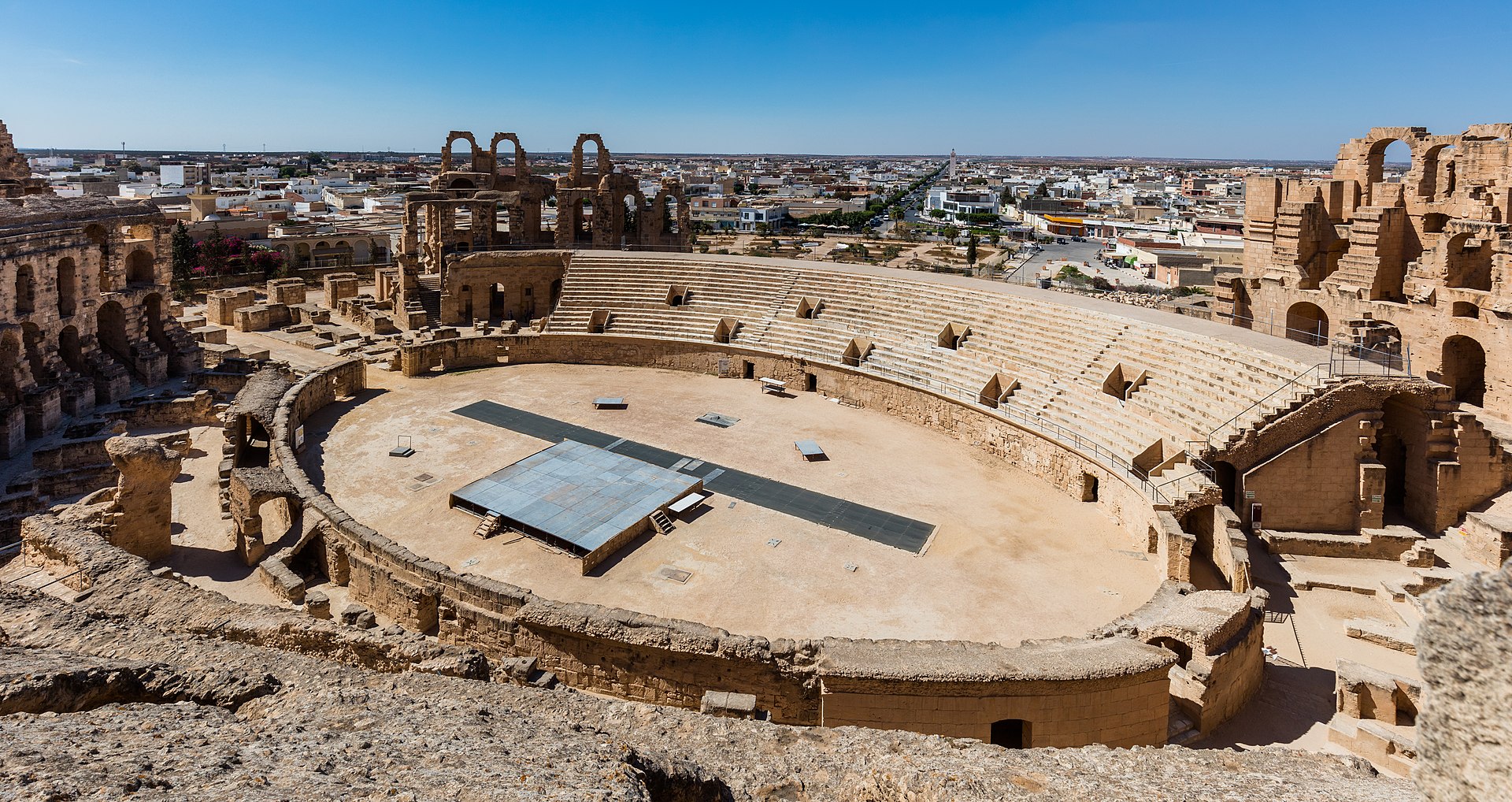
El Jem — The Arena
El Jem (UNESCO 1979) is one of the largest and best-preserved Roman amphitheatres, built for tens of thousands of spectators. Standing almost intact in the Tunisian countryside, it is among the most significant Roman monuments in Africa. Time here to absorb the scale of the arena and the surrounding countryside at an unhurried pace, with the El Jem mosaic museum nearby.
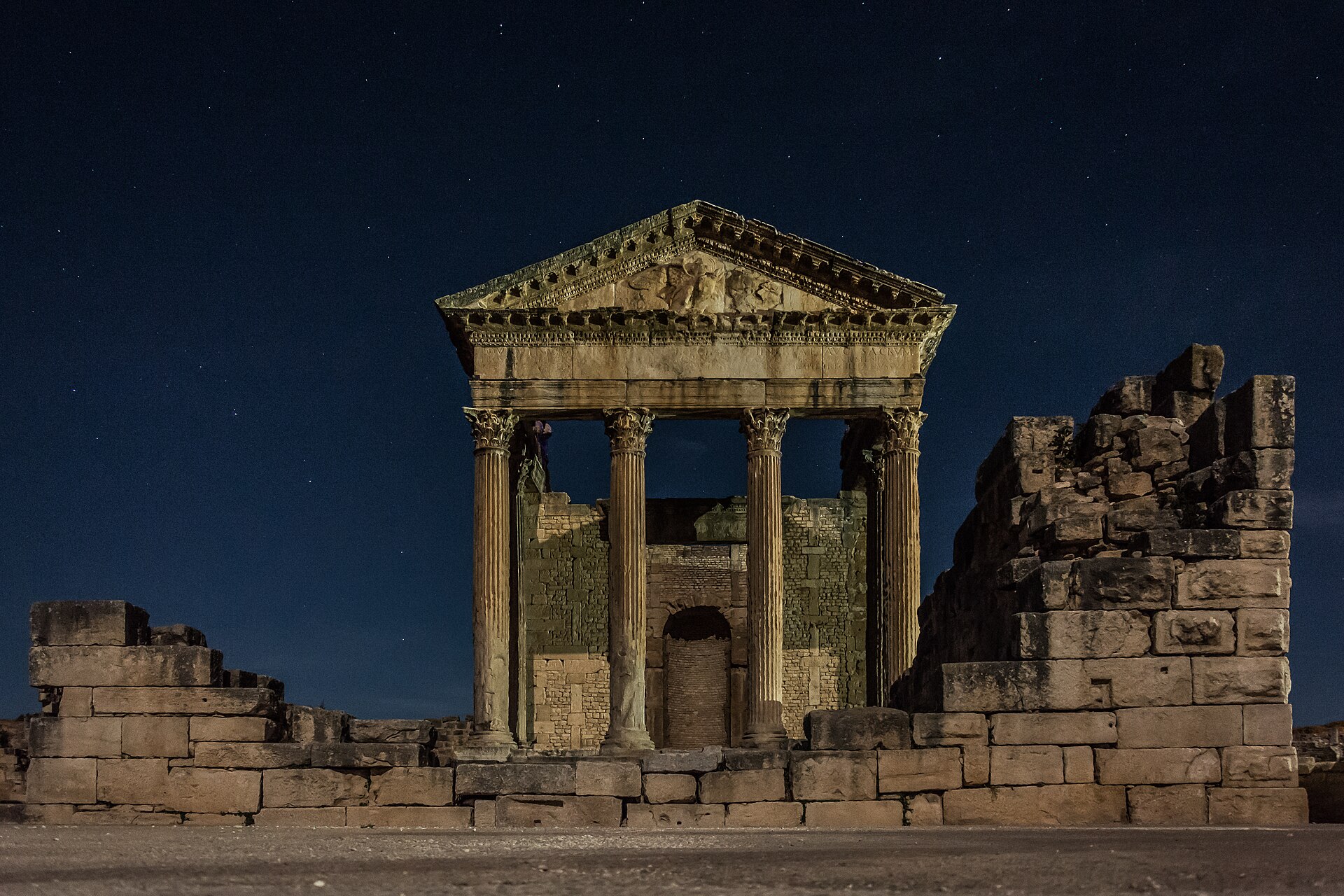
Dougga — The Acropolis
Dougga (UNESCO 1997) is one of the best-preserved Roman-period urban landscapes in North Africa. Capitol, theatre, baths, temples, market: a complete urban landscape from the 2nd and 3rd centuries CE, set on a hilltop overlooking the Tunisian countryside. A quieter, more contemplative counterpart to the great arena at El Jem.

Tunis — Departure
A final day in Tunis. The Bardo National Museum holds one of the world's finest collections of Roman mosaics, a fitting close to a journey through the Roman layer of North Africa. Optional: a farewell dinner at Sidi Bou Said overlooking the Gulf of Tunis.
International departure from Tunis-Carthage International Airport (TUN). A journey through the shore where Phoenician, Roman and Islamic civilisations converged.
Selected Distances & Transfers
| Segment | Distance | Transfer | Time |
|---|---|---|---|
| Tunis → Carthage & Sidi Bou Said | 14 km | Private City Transfer | ~30 min |
| Tunis → Kairouan | 125 km | Helicopter | ~35 min |
| Kairouan → El Jem | 70 km | Helicopter + Ground | ~20 min |
| El Jem → Tunis | 173 km | Helicopter | ~50 min |
| Tunis → Dougga (day excursion) | 96 km | Helicopter + Ground | ~25 min |
All times are indicative estimates and depend on aircraft type, routing and landing permissions, weather and operator approval. Distances are approximate straight-line values. El Jem and Dougga are reached by helicopter with a short ground transfer to the site itself. Carthage and the Bardo are within Tunis and reached by private city transfer. All helicopter and ground transfers are arranged through selected licensed operators.
Five UNESCO World Heritage Sites
Designed Around You
This itinerary is a route framework, not a fixed departure. Each Southern Cross journey is privately curated around your dates, travel rhythm, interests and preferred level of comfort. The route can be shortened, extended, or combined with another SCE journey — subject to aviation logistics and operational feasibility.
This Tunisian expedition pairs naturally with Morocco and its Trans-Sahara Trade Route — the caravan world of the Saharan trade — for a wider two-country North African journey. The route can also connect to an East or Southern African fly-in expedition for a Trans-Continental heritage journey.
Add Morocco and its Trans-Sahara Trade Route · Marrakech, Fez, the Sahara · a wider North African heritage journey.
A compact country traversed at an unhurried pace. Days can be added at the coast or for deeper time at the archaeological sites and museums.
Fly-In World Heritage Expeditions
This expedition is part of the Southern Cross Fly-In World Heritage Expeditions — journeys reaching Africa's natural and cultural World Heritage by air, understood, not just visited.
Indicative accommodation examples, selected for location and character. Final accommodation is confirmed during private route design. References to UNESCO World Heritage Sites are factual references to sites inscribed on the UNESCO World Heritage List. Southern Cross Experiences is an independent travel company and does not imply UNESCO endorsement of its journeys. All routings, charter arrangements, access and internal flights are subject to availability, security assessment and final operational validation.